Key takeaways
- Waterproof planks do not stop water from entering a basement or moisture from moving through concrete.
- Check your address and basement water history instead of assuming all Walkersville homes face the same risk.
- Use the exact product’s moisture limits and installation instructions, not just the waterproof label.
- Confirm who handles testing and preparation before buying materials or setting an installation date.
- Send Mike the product information, room photos, and notes about past water problems.
No. Waterproof vinyl plank does not make your Walkersville basement waterproof. The planks may resist water, but the concrete beneath them, past water entry, and the product’s installation limits still matter.
Before you buy, separate two questions: Can the plank handle moisture, and is your basement suitable for that floor? Those are not the same thing. Mike’s flooring services in Walkersville are a starting point for discussing your room, material choice, and installation needs.
What does waterproof vinyl plank actually protect?
A waterproof claim about a plank does not mean the installed floor becomes a sealed barrier. It does not repair a leaking foundation, stop seepage, or remove moisture beneath the flooring.
Water can also affect nearby materials. Baseboards and drywall may still get wet. A surface that looks dry does not establish that the concrete below it is ready for flooring.
For a product-specific example, Mannington’s ADURA Rigid installation guide requires concrete moisture checks and prohibits installation where excessive moisture emissions exist. It also explains that moisture beneath moisture-resistant planks can support mold and mildew.
That guide applies to that product. Another vinyl floor may have different requirements. Read the instructions for the exact floor you plan to buy, not just a brand’s general product description.
| What you find | What it means for your decision |
|---|---|
| A waterproof label on the carton | You still need to check installation requirements. |
| Concrete that looks dry | Appearance alone does not establish acceptable moisture conditions. |
| Water after heavy rain | Have the source evaluated before covering the slab. |
| Acceptable moisture-test results | Also consider water history and other product requirements. |
| Uneven concrete | Ask what preparation is needed before installation. |
Does living in Walkersville mean your basement is flood-prone?
No. A town-wide description cannot establish the condition of your property.
The Walkersville comprehensive plan describes broad floodplains along Israel Creek and the Monocacy River. The plan was adopted September 23, 2024, despite the 2025 date in its filename. That context is a reason to investigate your address, not a reason to label every local basement flood-prone.
Start with an address-based flood-map check. FEMA explains how to find flood information by street address. Treat the result as one part of your preparation, not a verdict on whether your basement is ready for vinyl.
Record any water entry, even if it happened only once. Note whether a sump pump, drainage work, or other changes were added afterward. A past repair is useful information, but it does not establish the slab’s current condition.
What should you check after rain?
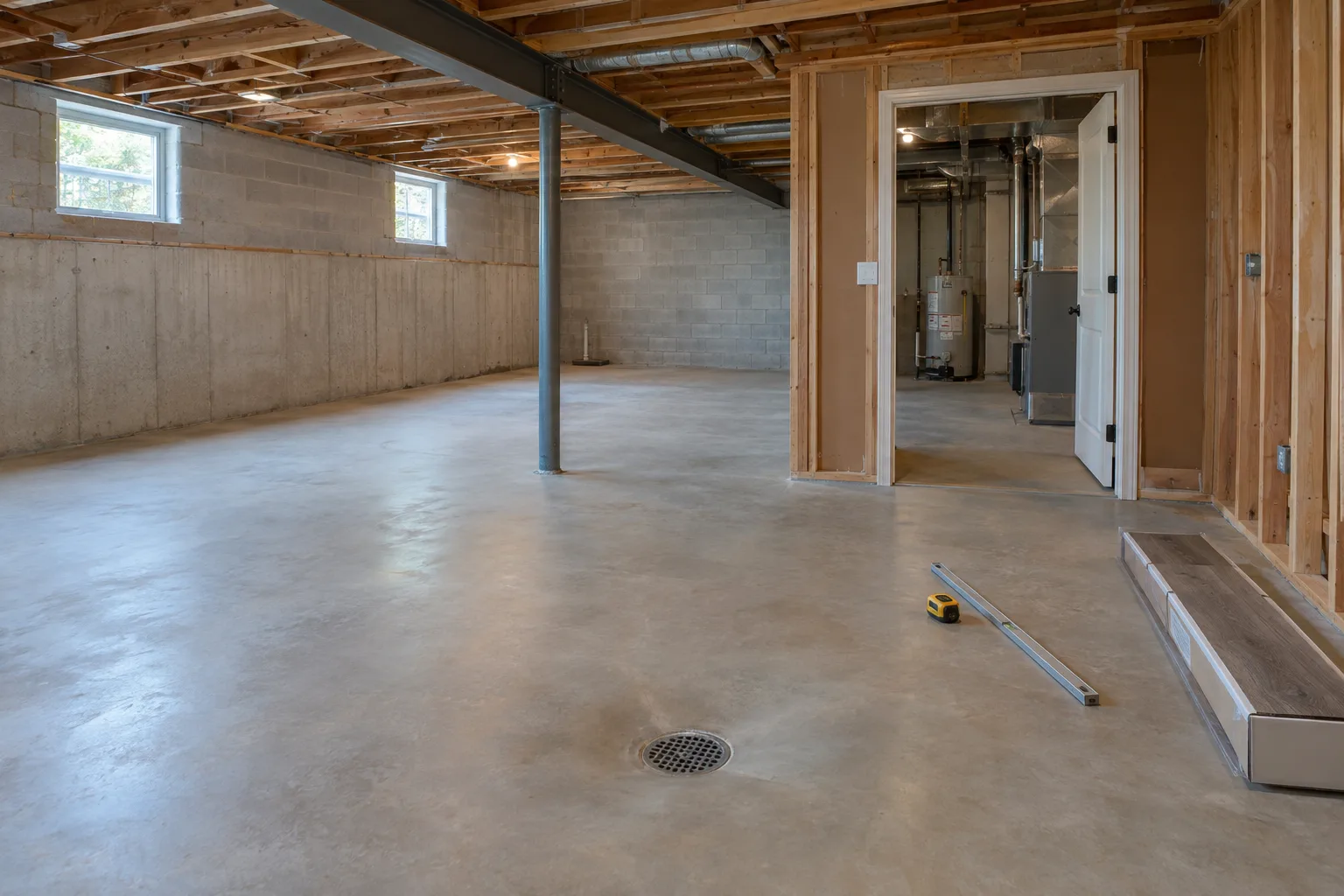
Walk through the basement after substantial rain, if you can do so safely. Gather this information before covering bare concrete or removing evidence of past moisture:
- Photos of wet spots, staining, or white deposits on concrete.
- Dates and locations of known water entry.
- Notes about damp odors or recurring condensation.
- Information about sump pump operation or backup events.
- Records of past drainage or foundation work.
- Photos of the existing floor and damaged areas.
These details help you explain what has happened. They are not a diagnosis. A stain alone does not tell you where moisture came from or whether the problem is resolved.
If water is still entering, pause the flooring purchase and have the source evaluated. Do not assume flooring installation includes drainage repairs or moisture-control work. Confirm Mike’s scope and arrange any needed outside work before installation.
What moisture information matters before installation?
Ask for the selected floor’s concrete requirements before deciding the basement is ready. You need the required testing method, acceptable limits, and any required moisture-control components.
A useful discussion covers four points:
- Who will perform or arrange the required testing?
- What do the results show, and when were they taken?
- Do those results meet the exact product’s requirements?
- What must happen if they do not?
Test results describe conditions at the time of testing. They do not erase a history of water after storms. Share both the readings and your observations.
Do not treat plastic sheeting as a universal fix. The Mannington guide cited above specifically rejects polyethylene over the slab as a solution for emissions above its limits. Other products may require particular layers or have different instructions. Follow the selected floor’s requirements rather than adding a layer by guesswork.
Confirm Mike’s testing role directly. Ask whether he conducts testing, arranges it, or needs results from another professional. Do not assume any particular testing service is included.
What should installation planning cover?
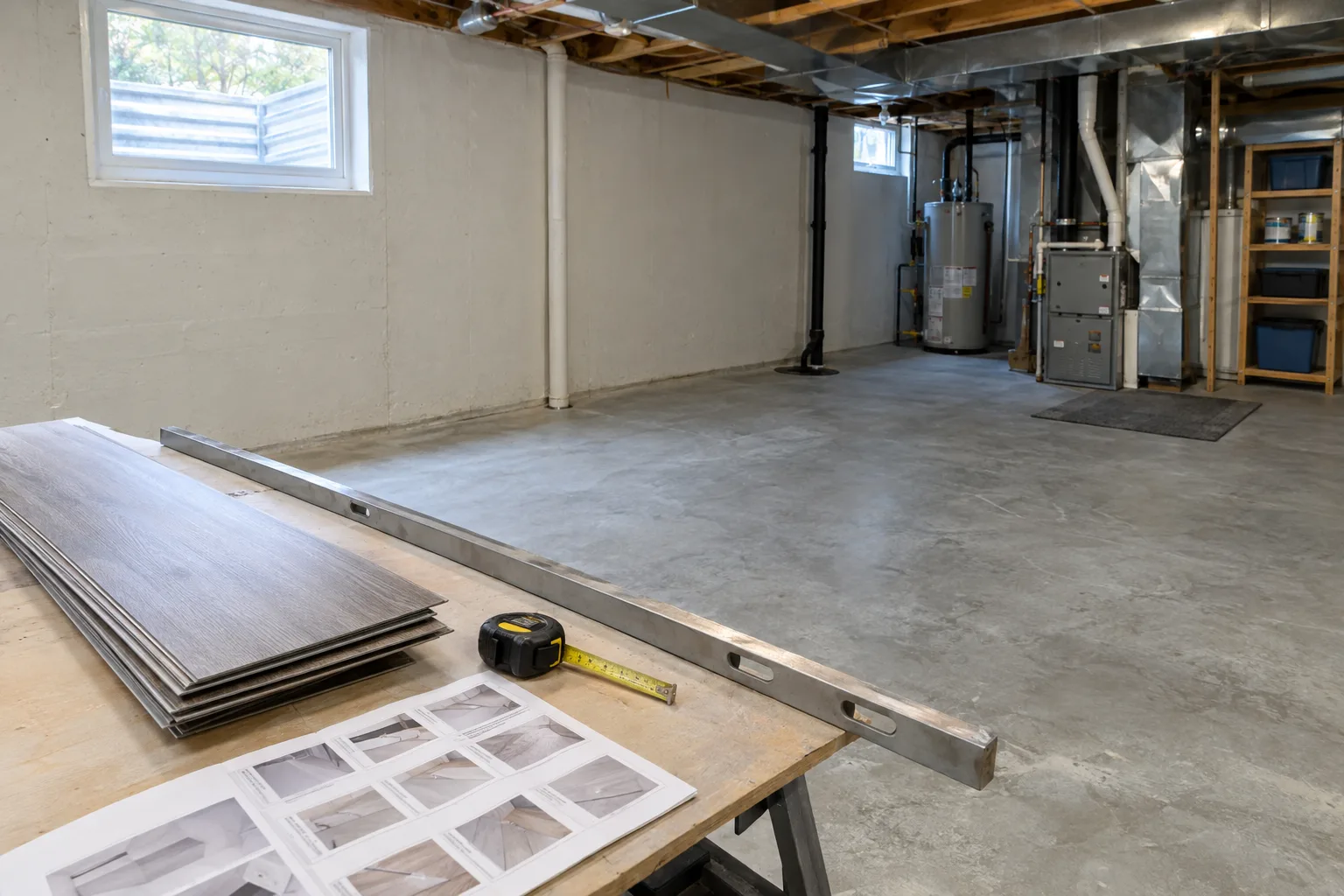
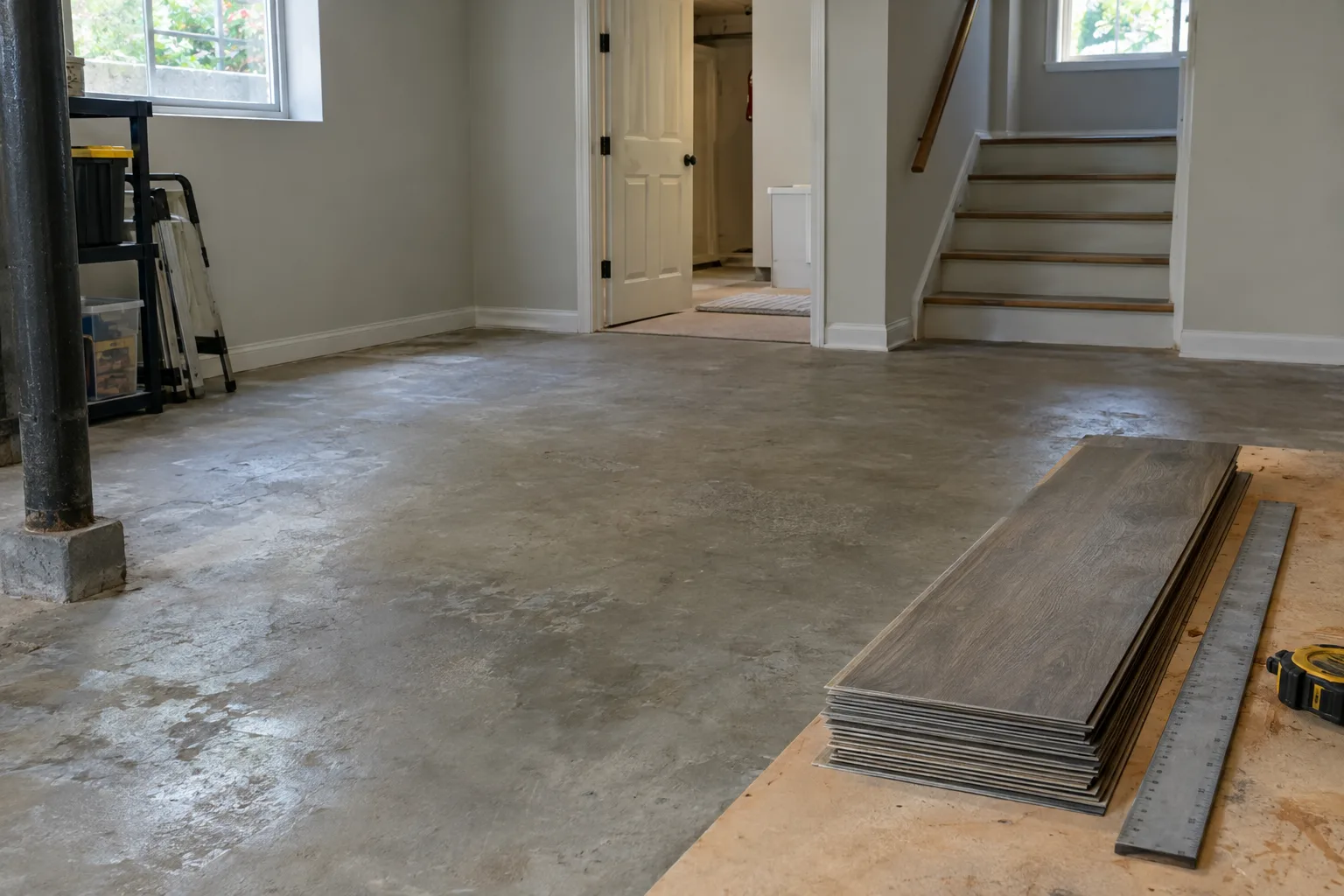
Square footage is only part of planning. Ask about slab flatness, existing flooring, and the finished floor height.
Flatness and level are not the same. A slab can slope while remaining flat enough for a particular floor. It can also appear level while having localized humps or dips. The selected product’s limits determine what needs attention.
Use this checklist when discussing your basement:
- Room dimensions and intended flooring boundaries.
- Flatness concerns and visible slab damage.
- Existing flooring and removal needs.
- Door clearance after installation.
- Transitions to nearby rooms or other flooring.
- Stair edges, landings, and changes in height.
- Required expansion space and trim details.
- Furniture, storage, or appliances that affect access.
The Mannington guide also calls for measured layout planning and expansion space. Those details matter even when moisture results are acceptable. A dry slab alone does not settle every installation question.
Ask Mike which preparation tasks are included and what would require another professional. Measuring a room should not be treated as a moisture diagnosis or an agreement to handle every concrete condition.
When should you choose and buy the vinyl?
You can narrow your choices first, but send Mike the exact product name and installation guide before buying. Include the model or collection, plank thickness, and attached pad information.
This lets you discuss below-grade suitability, moisture requirements, floor height, and layout before materials arrive. An attached pad does not remove the need to follow the instructions for concrete. Confirm the material quantity and any required accessories before placing an order.
You can select hardwood or vinyl plank at Baltimore Floor Works, 142 Railroad Ave. in Westminster, or at Lowe’s or Home Depot. You may buy the material yourself, or Mike can order the floor you selected, usually through Baltimore Floor Works. Mike does not bring samples to your house.
For service information, see Mike’s luxury vinyl plank and tile installation service. Current rates are on the flooring pricing page. The estimate tool shows a preliminary range that is not a contract.
Questions before you schedule
Can you install vinyl if the concrete looks dry?
Appearance is not enough. Check the exact product’s testing requirements and limits. Include your basement’s water history in the decision, even if the slab is dry when you look at it.
Can plastic under the planks solve a moisture problem?
Do not assume it can. The required layers depend on the selected floor. Mannington’s cited guide rejects polyethylene as a solution for emissions above its limits. Confirm the product requirements before buying underlayment or other materials.
Does Mike handle concrete moisture testing?
Confirm that directly with Mike. Ask who will perform or arrange the required tests and how the results will be available before installation. His specific testing role is not established here.
What is the next step for your basement?
Gather the product information, room photos, and water-history notes. Include moisture-test results and drainage records if you have them. Review Mike’s vinyl plank installation information, then discuss your basement before committing to materials.
Call or text Mike at (410) 259-7094. Leave a voicemail if he cannot answer. Confirm testing responsibilities, preparation scope, and unresolved water concerns before setting an installation date.
Questions people ask
Can you install vinyl plank if the basement concrete looks dry?
Appearance is not enough. Check the exact product’s testing requirements and acceptable moisture limits. Include your basement’s water history in the decision, even if the slab looks dry.
Does living in Walkersville mean your basement is flood-prone?
No. Walkersville’s comprehensive plan describes floodplains along Israel Creek and the Monocacy River, but that does not establish conditions at every property. Check your address using FEMA flood information and review your basement’s own water history.
Can plastic beneath vinyl plank solve a concrete moisture problem?
Do not assume it can. Follow the selected floor’s requirements. Mannington’s ADURA Rigid guide specifically rejects polyethylene over the slab as a solution for moisture emissions above its limits.
Does Mike conduct concrete moisture testing or arrange it?
Confirm that directly with Mike. Ask whether he performs testing, arranges it, or needs results from another professional. Do not assume a particular testing service is included.
What should you send Mike before buying basement vinyl plank?
Send the exact product name and installation guide, including the model or collection, plank thickness, and attached pad information. Include room photos, water-history notes, and any available moisture-test results.
Sources
- Walkersville Comprehensive Plan, adopted September 23, 2024
- Mannington ADURA Rigid Installation Guidelines, revised March 25, 2026
- Shaw Commercial SPC Installation: Substrate Testing
- FEMA Training: Flood Map Service Center Address Search
- MM Flooring: Luxury Vinyl Product-Browsing Destination
- Home Depot: Lifeproof Flooring