Key takeaways
- Choose board width by comparing your actual rooms and connecting doorways, not the bungalow label alone.
- Use full-scale paper strips to compare widths before choosing a factory-finished product.
- Check thickness, installation requirements, retained trim, and adjoining floor heights separately from width.
- Discuss indoor conditions, the space below the floor, and moisture checks before setting an installation date.
- For board repairs, matching depends on finding the same product or the closest available species, width, thickness, and finish.
For your Mount Airy bungalow, choose hardwood board width after comparing your rooms, connecting doorways, retained trim, and the chosen product’s installation requirements. Narrow and wide boards can both work, but neither is right for every bungalow. Start with the layout you have, then compare factory-finished products at full scale.
Start with your rooms, not the bungalow label
Mount Airy has more than one traditional house form. The town’s rehabilitation design guidelines document center-gable I-houses alongside early twentieth-century Foursquare and Bungalow forms. That gives you useful local context. It does not establish the original flooring width in your house or prove that your existing floor is original.
Your room layout is a better starting point than a style label. A bungalow with several small rooms presents different choices from one with walls removed between the living and dining areas.
First, decide the scope. Are you replacing a whole connected floor, one room, or only damaged boards? If an adjoining floor stays, its board width and direction become part of your decision.
For help planning a local job, see Mike’s flooring services in Mount Airy. Bring room information and product details rather than relying on a general description such as “wide plank.”
Compare narrow and wide boards at full scale
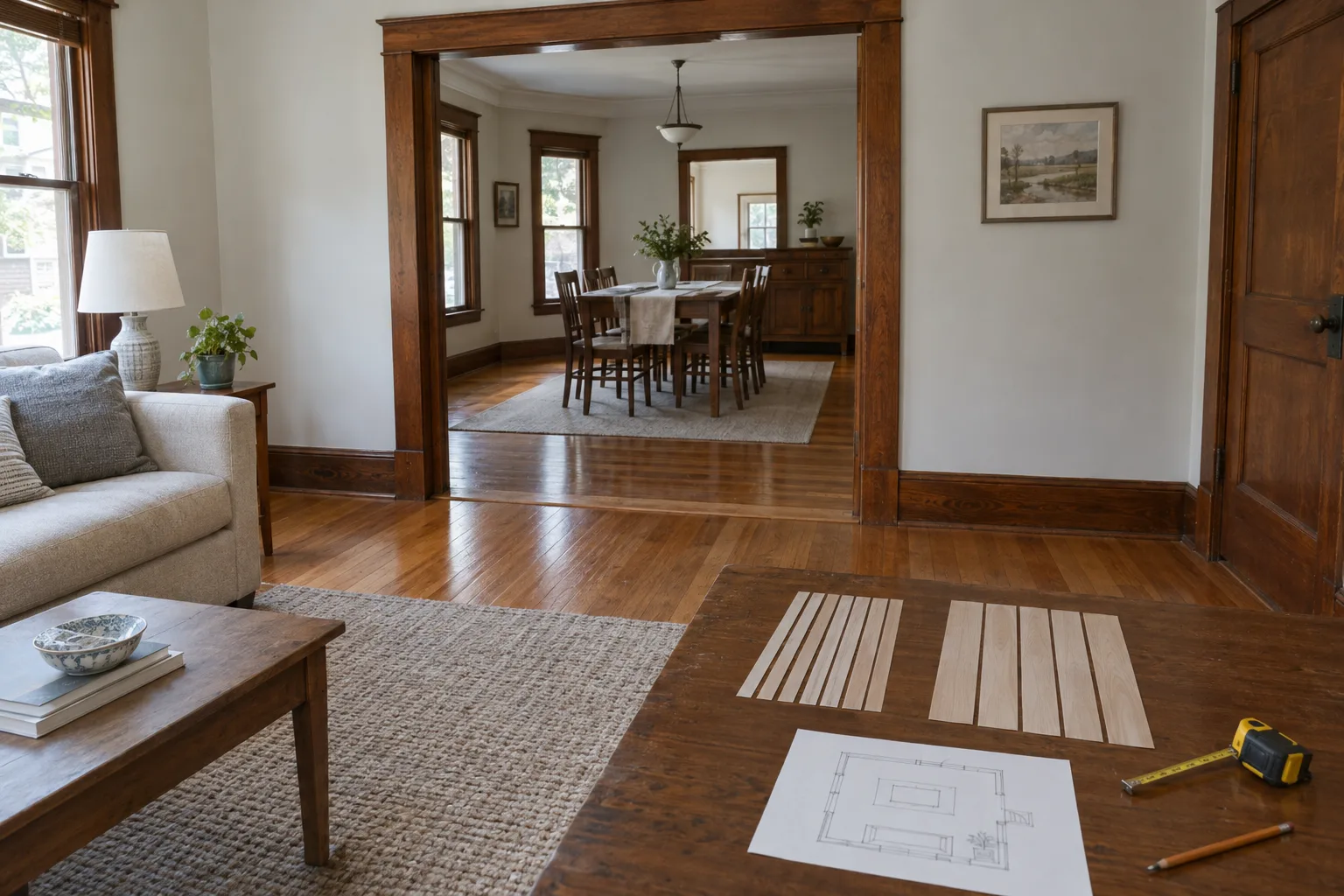
Sketch each room before you shop. Include room dimensions, doorway openings, closets, hearths, and adjoining floors that will remain. Mark the direction of the existing boards where you can see it.
Then cut paper strips to the widths of products you are considering. Lay several strips side by side on the floor. Do not judge a width from one strip alone.
View the mock-up from the front entry, from your usual seating position, and through connecting doorways. Repeat it in a smaller room. This is a practical visual comparison, not proof that one width makes a room look larger.
| What you compare | Narrower boards | Wider boards |
|---|---|---|
| Visible layout | More board edges across the same space | Fewer board edges across the same space |
| Connection to retained flooring | Compare with the existing width and direction | Check how the change reads at the doorway |
| Small rooms and short walls | Test the repeated board pattern | Test the board pattern and likely edge cuts |
| Installation | Follow the exact product instructions | Check for width-specific fastening requirements |
Compare similar colors and finishes when possible. Otherwise, a darker factory finish or stronger grain pattern may drive your preference more than the width itself.
Separate width from construction and thickness
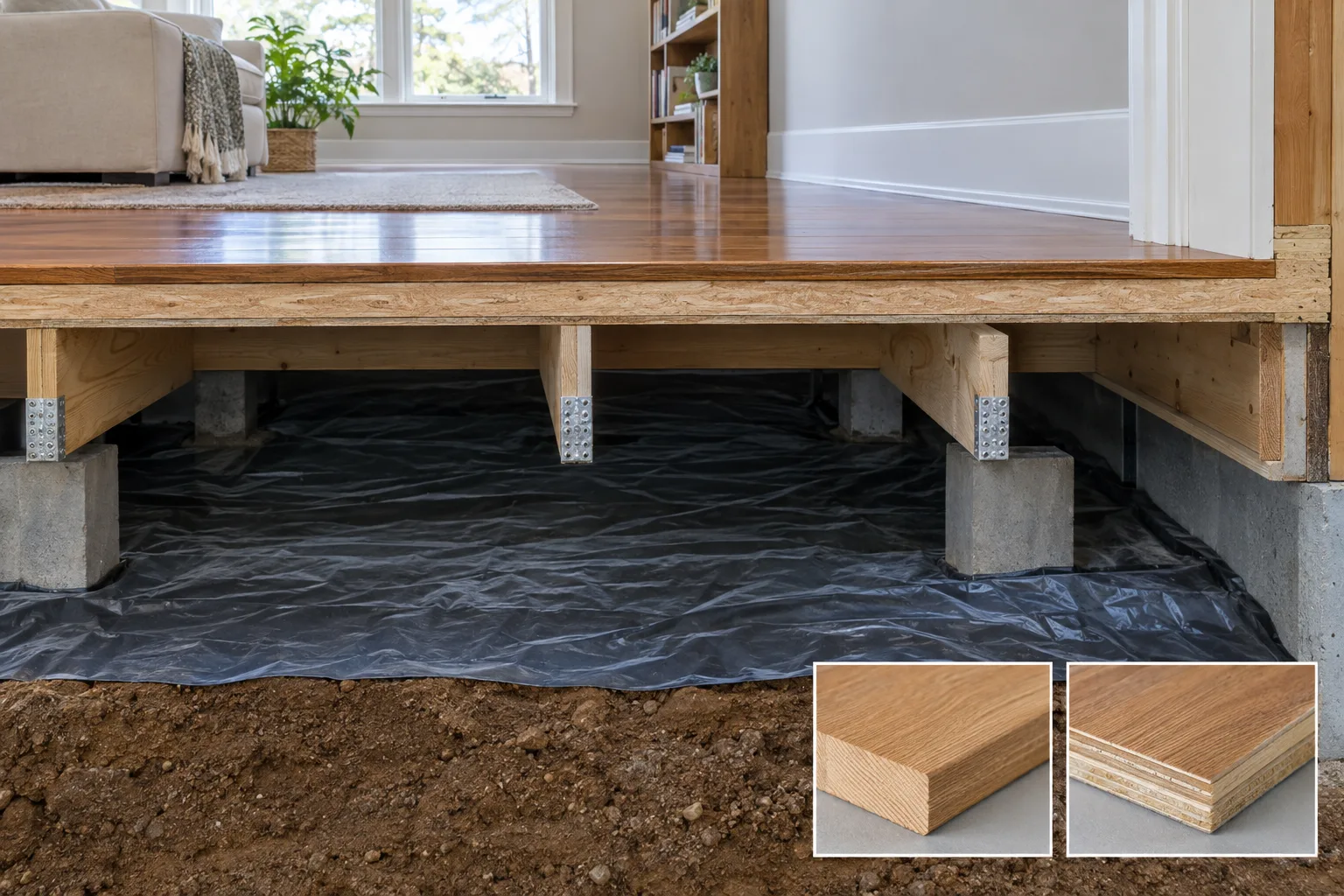
Board width does not tell you whether a floor is solid or engineered. It also does not tell you its total thickness or approved installation method.
Compare factory-finished products using their own instructions. For example, the Bruce engineered hardwood installation guide requires adhesive assistance with mechanical fastening for the products it covers that are more than five inches wide. That is a manufacturer-specific example, not a rule for every hardwood floor.
Before choosing a product, gather:
- The manufacturer and exact product name.
- Board width and total thickness.
- Solid or engineered construction.
- The installation guide.
- The factory finish and species.
See Mike’s hardwood floor installation page when planning a new floor. The installation service details can also help you prepare your questions. Mike does not sand, refinish, stain, or finish unfinished flooring. Choose a factory-finished product for the work discussed here.
Resolve the layout before ordering
A width that looks good in a sample still needs a workable layout. Before ordering, ask Mike which measurement, moisture-testing, trim-handling, and preparation steps are included in your job.
Use this checklist for that discussion:
- Room dimensions: Confirm the areas being covered, including closets and connecting spaces.
- Doorway layout: Discuss where boards continue and where transitions may be needed.
- Perimeter cuts: Ask how the layout affects the last rows along walls.
- Retained trim: Identify the baseboards and door casings you want to keep.
- Floor heights: Compare the new assembly with adjoining floors and door clearance.
- Subfloor condition: Discuss uneven areas, movement, damage, or signs of moisture.
- Expansion space: Follow the selected product’s requirements around walls and fixed objects.
Do not assume existing baseboards will cover every required gap. Do not assume a thinner product will solve every doorway issue. The flooring, subfloor, trim, and transitions need to be considered together.
These are questions to resolve with Mike, not a promise that every preparation task is included automatically.
Make moisture part of the decision
Wood gains moisture and swells in humid conditions. It loses moisture and shrinks in dry conditions. Consider width alongside the product’s limits and the conditions in your home.
Think about the space below the floor. Is it a conditioned basement, an unfinished basement, a crawl space, or another room? Tell Mike about dampness, musty odors, past leaks, or gaps that change with the seasons.
The National Wood Flooring Association’s guidance on seasonal wood-floor movement calls for recording room conditions and checking moisture in both the flooring and subfloor before installation. Conditioning flooring is about compatibility with the home, not simply leaving boxes inside for a fixed number of days.
Ask about recording indoor temperature and relative humidity, checking the flooring and subfloor, and following the product’s conditioning instructions. Also discuss how you will manage indoor humidity after installation. Choosing narrow boards is not a substitute for addressing moisture concerns.
Plan around boards that will stay
If you are repairing damaged boards, the existing floor narrows your choices. A different width or thickness can create problems even when the color looks close.
For hardwood board repairs, matching depends on sourcing the same product or the closest match available in species, width, thickness, and finish. An exact or invisible match may not be possible.
Mike does not sand or refinish boards to make a repair blend in. If you are keeping one room and replacing another, compare the actual products at the connecting doorway before ordering.
Prepare for the next step
Choose your hardwood at Baltimore Floor Works, 142 Railroad Ave. in Westminster, or at Lowe’s or Home Depot. Mike does not bring samples to your house. You can buy the material yourself, or Mike can order the floor you picked, usually through Baltimore Floor Works.
Keep the exact product details with your room sketch. Note which floors and trim will remain. Include any known moisture concerns and questions about furniture, removal, and preparation.
Current rates are on the flooring pricing page. The estimate tool provides a preliminary range that is not a contract.
Call or text Mike at (410) 259-7094 to discuss your Mount Airy project. Leave a voicemail if nobody answers.
Questions people ask
Are wide boards wrong for a bungalow?
No. Compare them in your actual rooms and doorways. The house style alone does not establish the right width or prove what was originally installed.
Should every connected room use the same width?
Not necessarily. If some flooring stays, compare widths, direction, thickness, and the transition before choosing a new product.
How long should hardwood sit in the house before installation?
Follow the selected product’s instructions and moisture requirements. A fixed number of days alone does not establish readiness.
Can damaged boards be matched without replacing the whole floor?
Sometimes. The choice depends on finding the same product or the closest available species, width, thickness, and finish. Mike does not sand or refinish to blend a repair.
Sources
- Town of Mount Airy: Design Guidelines for Rehabilitation of Historic Properties, page 10
- NWFA Wood Flooring Installation Guidelines
- NWFA: Avoiding Winter Weather Woes
- Bruce Engineered Hardwood Installation Instructions
- The Home Depot: Avila Engineered Hardwood
- Mill Direct Floor Coverings: Hardwood Products
- The Home Depot: Malibu Wide Plank Wood-Look Flooring