
Key takeaways
- A waterproof plank does not make a damp, uneven, or unsound subfloor ready for installation.
- Measure door clearance against the planned finished floor height and your entrance mat.
- Check the exact product guide before buying extra padding or planning installation conditions.
- Plan transitions and fixed storage so a floating floor remains free to move.
- Have the product details and a list of known moisture problems ready for measurement.
LVP for a mudroom can be a practical choice, but a waterproof plank does not make the floor underneath it ready. The Shaw WPC installation guide requires a clean, flat, dry, structurally sound subfloor and warns about excessive moisture below the flooring.
Before buying for your Taneytown entrance, check more than color and the waterproof label. Your selected product needs to fit the room conditions, door clearances, adjoining floors, and storage layout.
Use the checklist below to prepare for a real measurement visit. Your notes help identify questions, but they do not replace checking the floor on site.
Start with how you use the entrance
Walk through your mudroom as you would with groceries, muddy shoes, or a wet dog. Notice where boots land and where water collects. Open every door, including closet and laundry doors.
Write down:
- Which entrance gets the most use.
- Where wet footwear and mats sit.
- Whether benches and cubbies are movable or built in.
- Whether a washer or other appliance shares the room.
- Whether the entrance stays heated and cooled throughout the year.
A freestanding bench can be moved for installation. Built-in storage needs a plan before a floating floor goes down. An appliance may also affect access and finished-height planning.
These details give you a useful starting point when discussing luxury vinyl plank and tile installation with Mike.
Measure finished floor height before ordering
The important measurement is the planned finished floor height, not just the plank thickness printed on the box.
That height may include the selected plank, permitted underlayment, and preparation beneath it. Removing an existing floor layer can change the calculation. Do not assume the new surface will sit at the same height as the old one.
Prepare this checklist for your Taneytown mudroom:
| Item to record | Question to resolve |
|---|---|
| Door swing and bottom clearance | Will every door clear the finished floor and entrance mat? |
| Exterior threshold height | How will the flooring end at the entrance? |
| Adjoining floor heights | What transition will connect each surface? |
| Existing floor layers | What is present, and what may need removal? |
| Visible floor condition | Are there soft spots, loose areas, or uneven sections? |
| Fixed storage locations | Where must movement space be maintained? |
| Heating and cooling | Does the room stay conditioned throughout the year? |
Include your actual entrance mat in the discussion. A door that clears bare planks may catch a thick mat. Ask who will handle any needed door or threshold changes before work is scheduled.
Separate wet boots from moisture underneath
Wet boots put water on top of the floor. A leaking threshold, damp concrete slab, or plumbing leak can introduce moisture underneath. Those are different problems.
A waterproof label does not tell you that the subfloor is dry or that a leak has been corrected. Tell Mike about recurring dampness, musty smells, soft areas, and water that appears after rain. Identify the source before covering the area.
Concrete needs attention even when its surface looks dry. The Mannington ADURA Rigid installation guide calls for concrete moisture checks. Follow the selected product's testing requirements rather than relying on appearance alone.
For daily use, remove grit and clean up tracked-in water promptly. Choose mats and cleaning products permitted by the flooring manufacturer. A waterproof plank is not a reason to leave puddles at the door.
Read the exact product guide
Do not apply one installation rule to every LVP product. Find the instructions for the exact collection and item you plan to buy.
Check these points before ordering:
- Approved subfloors and existing floor coverings.
- Flatness and moisture requirements.
- Permitted room temperatures and operating conditions.
- Acclimation requirements, if any.
- Required expansion space.
- Rules for attached pad and additional underlayment.
- Instructions for transitions and fixed objects.
For example, Mannington ADURA Rigid does not specifically require acclimation and does not recommend additional pad. Those are product-specific instructions, not rules for all vinyl plank.
Do not buy extra cushioning on the assumption that more padding is better. Confirm what the selected flooring permits first. Save the product name, item number, thickness, and installation guide so Mike can review the same information you used while shopping.
Check whether the room stays conditioned
A heated and cooled entrance is not the same setting as an enclosed seasonal porch. Tell Mike if you close a heat register, shut off cooling, or leave the mudroom unheated for part of the year.
Check the exact product's allowed room conditions. Do not assume that a floor sold for indoor use suits every enclosed entrance.
Also note where the room connects to the rest of the house. A door that stays closed between the mudroom and kitchen may affect how the entrance is conditioned. Describe how you actually use the space, not just how the room is labeled.
Resolve any uncertainty about product suitability before delivery or removal of the existing floor.
Plan transitions and built-in storage
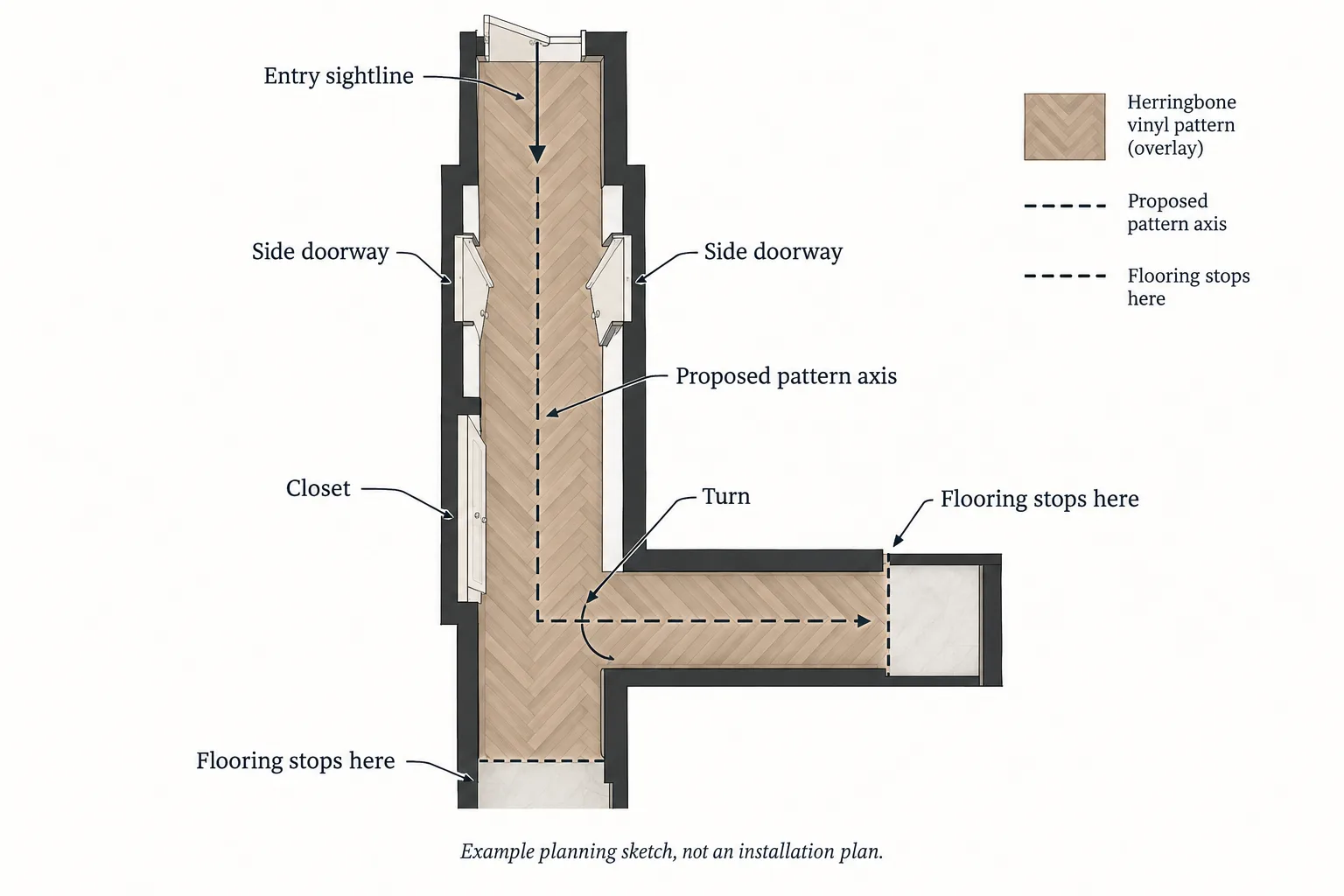
Treat each doorway as a separate detail. Your kitchen floor may sit at a different height than the hall or laundry floor. Mannington's guide calls for transition planning around subfloor elevations and changes in substrate.
Ask how each connection will be handled with your selected flooring. Include the exterior threshold, not just interior doorways.
A floating floor must remain free to move as its instructions require. Mannington ADURA Rigid says not to install cabinets on top of the floor or fasten transitions through its planks.
Mark which benches and cubbies are fixed. Ask how flooring edges, movement space, and trim will work around them. If you plan to add built-in storage later, raise that now. Do not assume you can place and fasten it over a floating floor after installation.
Get ready for measurement
Clear access to door bottoms, thresholds, adjoining floors, and any visible problem areas. Have your product information ready, even if you have not bought the flooring yet.
Point out known leaks, seasonal dampness, and changes in heating or cooling. List the floor layers you know about, but leave unknown layers marked as unknown.
Ask which preparation decisions can be made during measurement and which depend on seeing beneath the existing covering. A visible surface does not reveal every issue below it. Clarify any unresolved preparation and door-work responsibilities before scheduling the job.
Choose materials and plan your next step
You pick your hardwood or vinyl plank at Baltimore Floor Works, 142 Railroad Ave., Westminster, or at Lowe's or Home Depot. You can buy the flooring yourself, or Mike can order your selection, usually through Baltimore Floor Works. Mike does not bring samples to the house.
Mike has installed floors for 31 years, since 1995. The service area extends about 50 miles from the Taneytown office, including nearby Westminster, Keymar, Union Bridge, and Littlestown.
Start with Mike's luxury vinyl plank and tile installation service. Current rates are on the flooring pricing page. The preliminary flooring estimate shows a preliminary range that is not a contract.
Call or text (410) 259-7094 to discuss your mudroom. Leave a voicemail if nobody answers. Have the product name and your entrance checklist ready so the conversation can focus on what needs checking before you buy.
Questions people ask
Is waterproof LVP enough for a mudroom with a damp subfloor?
No. A waterproof plank does not make a damp subfloor ready. Identify known leaks and follow the exact product's subfloor and moisture-testing requirements before installation.
What should you measure before buying mudroom LVP?
Record door clearance, threshold height, adjoining floor heights, existing floor layers, visible floor problems, and fixed storage locations. Include the entrance mat when checking door clearance.
Should you buy extra padding for mudroom LVP?
Only if the exact product's instructions permit it. Some products have attached pad or restrict additional underlayment. Confirm the requirements before buying accessories.
Can built-in mudroom cabinets sit on a floating LVP floor?
Check the selected product's instructions before planning storage. Mannington ADURA Rigid says not to install cabinets on top of its floating floor. Fixed storage and transitions need a plan that preserves required movement.
Sources
- Metroflor: Mudrooms are Becoming a Must, and Luxury Vinyl Flooring Offers the Best Protection
- Builders Interiors: Mudroom Flooring Ideas: How to Choose the Best Floor for a High-Traffic Space
- Carla Bast Design: Tips on Luxury Vinyl Plank and DIY Flooring Guide
- Shaw PDMS: Resilient Installation Guidelines for WPC Products
- Mannington: ADURA Rigid Installation Information
- Mannington: ADURA Rigid Installation Guidelines, revised March 25, 2026