Key takeaways
- Get the exact collection, product number, dimensions, and installation instructions before buying.
- Choose the installation system before settling on tile size, layout, or grout.
- Compare tile sizes in your measured room, including border cuts and doorway alignment.
- Use actual grout only when the selected product permits it, and confirm the installation scope with Mike.
- Check the base, moisture requirements, and finished floor height before ordering.
Stone look luxury vinyl tile should be chosen by its exact product and installation system, not just its pattern. Before you buy, confirm the tile size, joint treatment, base requirements, and layout in your measured room. A stone appearance does not make two vinyl tiles interchangeable.
For your home near Taneytown, discuss the selection with Mike before ordering. Start with his luxury vinyl plank and tile installation service. If you want actual grout between tiles, confirm the product and proposed work rather than assuming grout is part of every vinyl installation.
Check the product name, not just the stone pattern
A display label that says “stone look” is not enough. Two tiles with similar marble or slate patterns may need different installation methods.
Ask the retailer for:
- The manufacturer, collection, and exact product number.
- Tile length, width, and thickness.
- The edge detail and intended joint appearance.
- The current installation instructions.
- Any required adhesive, underlayment, or accessories.
Keep this information together. A photo of the display can help identify a pattern, but it does not replace the product number and instructions.
Send Mike those details before purchasing. You can then discuss the selected system, room conditions, and work involved before material arrives. This also helps you avoid buying accessories intended for a different floor.
Understand how the floor attaches
A fully adhered floor is bonded to a suitable base with the specified adhesive. A floating locking floor connects at its edges and must remain free to move as its instructions require.
That difference affects more than installation day. It can change how you plan around cabinets, islands, doorways, and adjoining rooms.
For example, Mannington's ADURA Rigid installation guide describes a floating angle/angle system. It prohibits fastening the floor to the subfloor and installing cabinets or islands on top. Those are rules for that product, not a complete rulebook for every vinyl tile.
For either system, check the requirements for the base, joint treatment, fixed objects, and transitions. A floating floor still needs a suitable base. A fully adhered floor still needs the correct adhesive and preparation.
Choose the system before settling on a layout. Do not assume that another product in the same color can be substituted without checking its instructions.
Compare tile sizes in your measured room
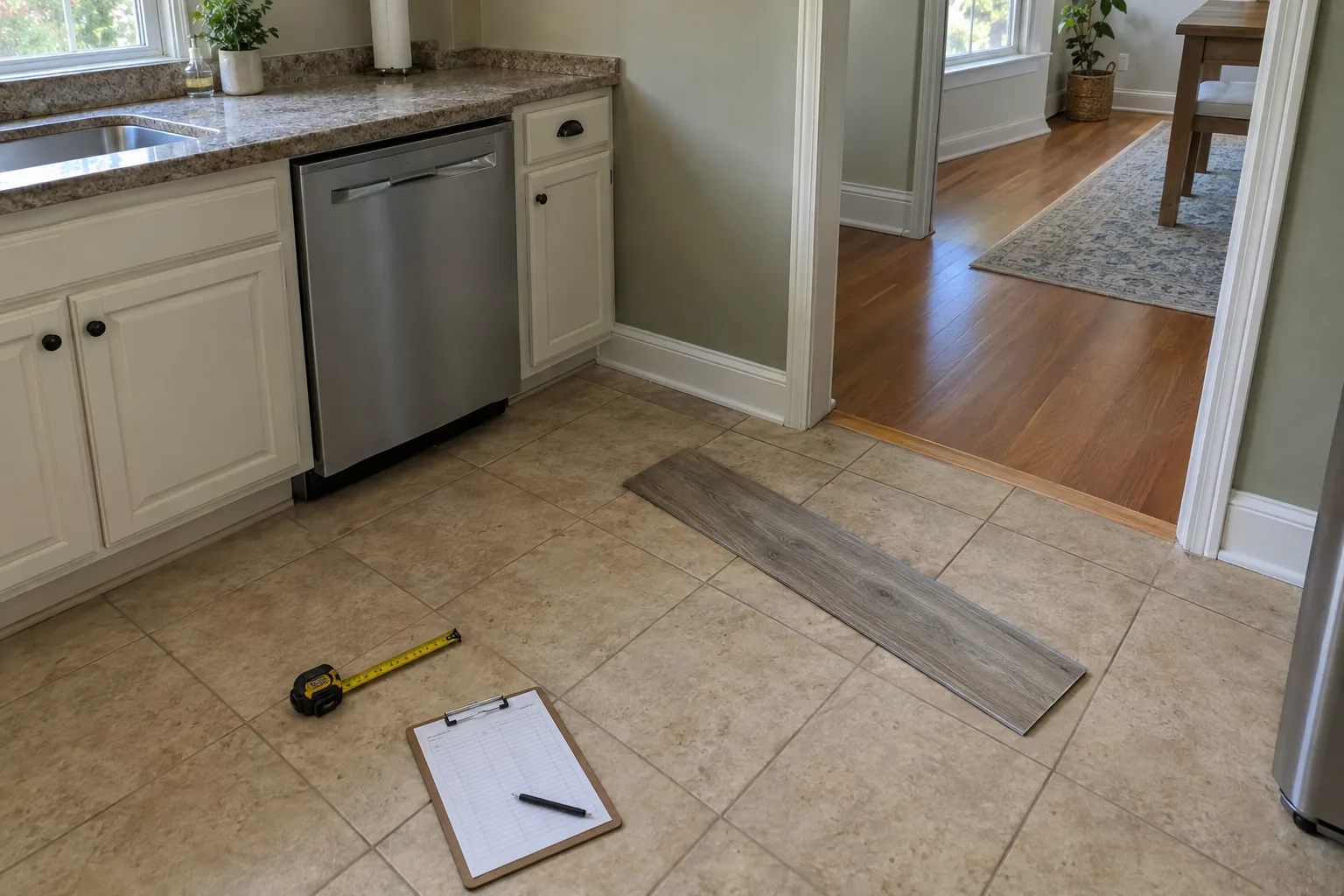
Use 12-by-24-inch and 18-by-36-inch formats as shopping comparisons, not automatic recommendations. A larger tile does not always make a small room look bigger.
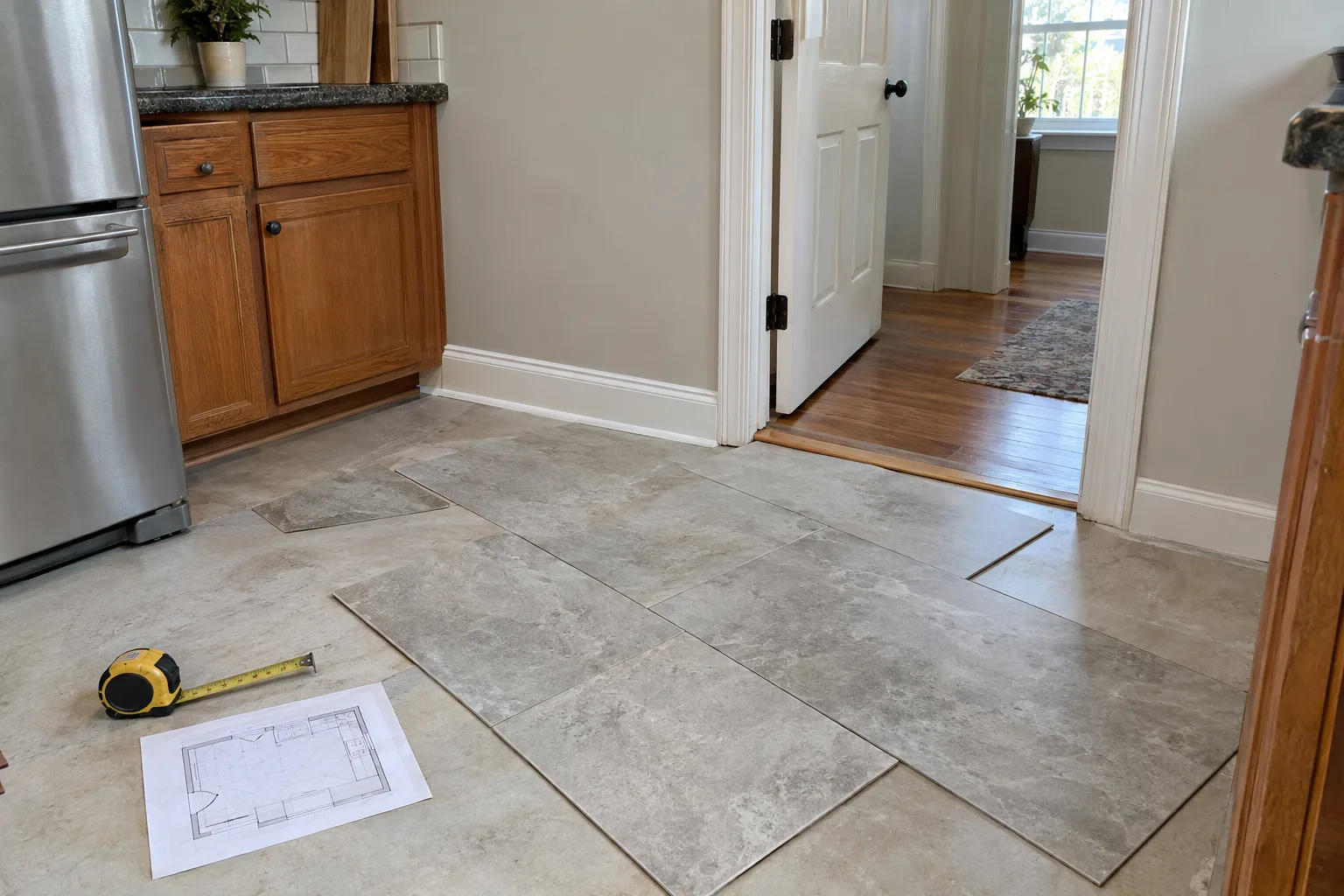
Measure the actual floor area and openings. Then compare how each size fits. Look at the number of rows, the location of joints, and the width of cuts along the walls.
In a Taneytown kitchen, you might prefer the pattern in one direction but find that it leaves a narrow strip beside the cabinets. Turning the layout may improve that cut while changing how joints meet the doorway.
Ask these questions before choosing:
- Where will the most visible full tiles sit?
- How wide will the border cuts be?
- Will joints meet a doorway awkwardly?
- Does the product require a specific offset or direction?
- How will the pattern look from the main entrance?
Use painter's tape to outline a few tile dimensions if it helps you picture the scale. Treat that as a visual aid, not the final installation layout.
Decide what the joints will be
Closed locking joints, decorative edges, and actual grout are different details. Identify which one your selected product uses before calculating rows and cuts.
A decorative edge can suggest a joint without leaving space for grout. Do not add grout to a locking floor unless its instructions expressly allow it. Likewise, a “groutable” label does not tell you which grout or joint width to use.
Mannington's grout guidance identifies specified products, including ADURA Flex and ADURA APEX Hexagon, that permit actual grout. That is not permission to grout every stone-look vinyl floor.
For eligible tile, Mannington's ADURA Flex instructions specify ADURA Grout with joints from 1/16 to 3/16 inch. The joint width must be included in layout measurements. Cement-based and epoxy grouts are not permitted for that system.
Those are product-specific rules, not general LVT specifications. Even a small joint adds up across several rows, so a grouted layout needs different measurements from a closed-joint layout.
Before buying a groutable product, ask Mike whether he can take on that exact system, including the grout work. Manufacturer approval does not establish the scope of Mike's installation service.
Check what is under the floor before ordering
A floating floor is not a substitute for checking the base. Both floating and adhered products need suitable conditions beneath them.
Identify the existing flooring layers and the material below them. Do not assume what is there based on your home's age. Ask whether the base is flat, structurally sound, dry enough for the selected product, and suitable for the planned installation.
The ADURA Rigid guide, for example, requires concrete moisture checks and a flat, sound base. Other products may have different testing and preparation requirements. There is no single moisture limit to apply to every vinyl floor.
If you see loose flooring, soft areas, raised seams, or signs of moisture, point them out before ordering. Conditions hidden beneath existing flooring may need further evaluation once exposed.
Work through the room details before committing
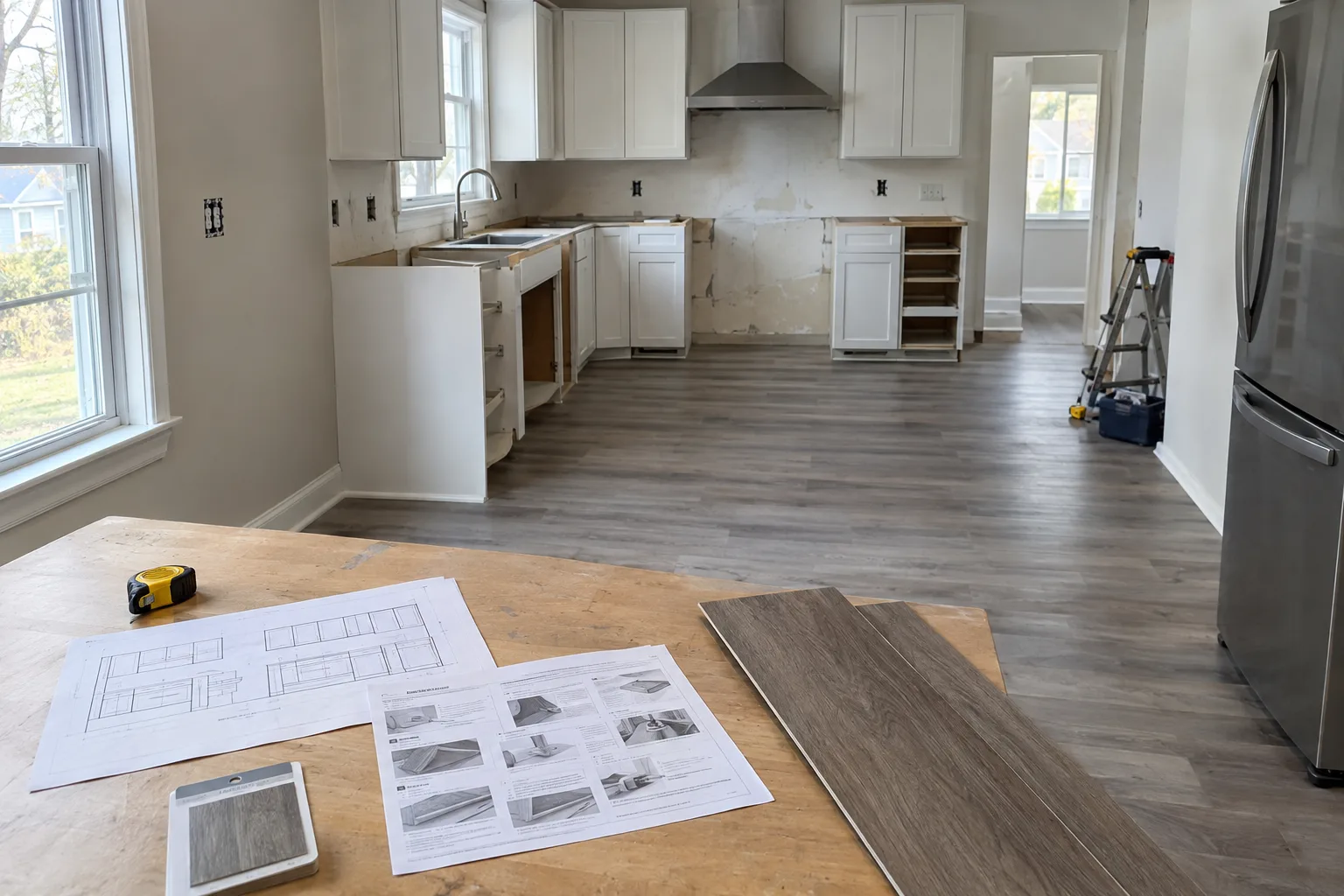
Use this checklist to prepare for a discussion about your kitchen, entry, or bathroom. It is a homeowner planning guide, not Mike's exact visit sequence.
- Measure the floor area and openings.
- Compare tile directions and any required pattern offsets.
- Check border cuts and doorway alignment.
- Identify existing layers and inspect accessible areas of the base.
- Compare the proposed finished height with adjoining floors.
- Confirm transitions, movement space, and the installation system.
For a bathroom, discuss the doorway and fixtures. For an entry, look closely at the connection to the next room. In a kitchen, identify fixed cabinets, islands, and appliance openings before planning the floor height.
The ADURA Flex guide calls for accurate measurements, a balanced layout, and attention to directional arrows. The Rigid guide also identifies elevation changes and complicated layouts as transition considerations. These details belong in the planning discussion, not just on installation day.
Ask Mike which conditions can be checked before removal and which may remain unknown. Resolve what you can before committing to material quantities and accessories.
Choose materials and plan the next step
You can select flooring at Baltimore Floor Works, 142 Railroad Ave., Westminster, or at Lowe's or Home Depot. Check that the retailer can supply the exact product and installation accessories you need.
You can purchase the material yourself, or Mike can order the floor you selected, usually through Baltimore Floor Works. Mike does not bring samples to your house.
Mike has installed floors since 1995, with 31 years of installation experience. He serves homes about 50 miles from the Taneytown office, including Westminster, Gettysburg, Hanover, and nearby communities.
Current rates are on the flooring pricing page. The estimate tool shows a preliminary range that is not a contract. Preparation needs, layout, and the selected product still need discussion.
Call or text Mike at (410) 259-7094 with your room details and product information. Leave a voicemail if he does not answer.
Common questions
Can every stone-look vinyl tile be grouted? No. Some products permit actual grout, while others use closed joints or decorative edges. Follow the exact product's instructions for grout type and joint width.
Should you choose tile size before the installation system? No. Identify the exact product and system first. Then compare tile dimensions, joint widths, and border cuts in your measured room.
What should you send Mike before buying? Send the manufacturer, collection, product number, dimensions, and installation guide. Include your room details and whether you want actual grout so you can discuss the proposed work.
Questions people ask
Can every stone-look vinyl tile be grouted?
No. Some products permit actual grout, while others use closed joints or decorative edges. Follow the exact product's instructions for grout type and joint width. Confirm the proposed installation scope with Mike before purchasing.
Should you choose tile size before the installation system?
No. Identify the exact product and system first. Then compare tile dimensions, joint widths, and border cuts in your measured room.
What should you send Mike before buying?
Send the manufacturer, collection, product number, dimensions, and installation guide. Include your room details and whether you want actual grout so you can discuss the proposed work.
Where can you choose flooring materials?
You can select flooring at Baltimore Floor Works, 142 Railroad Ave., Westminster, or at Lowe's or Home Depot. You can buy the material yourself, or Mike can order your selection, usually through Baltimore Floor Works. Mike does not bring samples to your house.
Sources
- The Home Depot: 18x36 Vinyl Tile Flooring
- Armstrong Flooring: Vinyl Flooring That Looks Like Stone
- Lowe's: Stone Look Tile Vinyl Tile
- Stone Tile Depot: Marble & Stone Look Vinyl Tile
- Mannington: About ADURA Grout
- Mannington: ADURA Flex Installation Instructions, 2026
- Mannington: ADURA Rigid Installation Guide, revised March 25, 2026